Get private stablecoin infrastructure right
Private stablecoins are issued by financial technology businesses and fintech institutions, not central banks. Before building your settlement layer, you must define the compliance boundaries. This is not a generic crypto integration; it is a regulated financial utility.
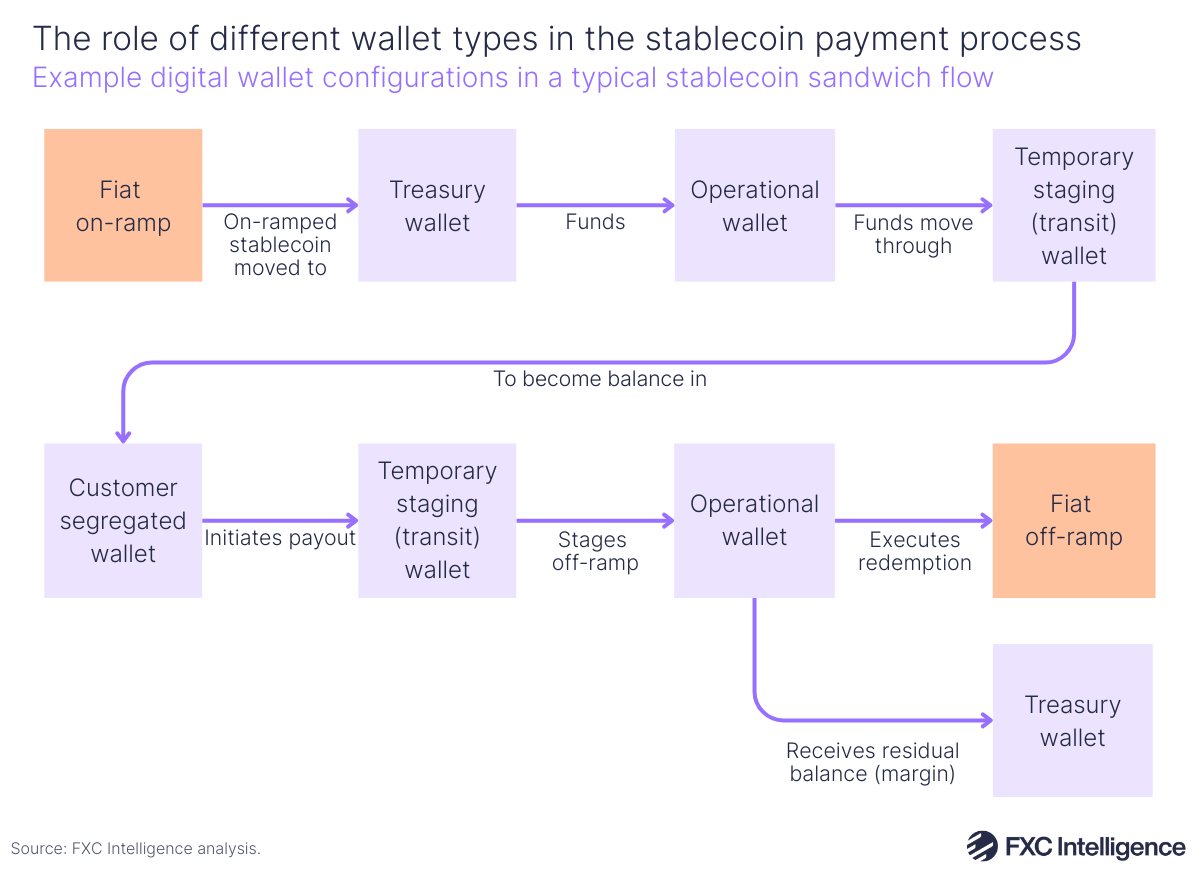
The infrastructure is the backend plumbing connecting your traditional operations to digital currency. It requires specialized APIs and protocols that handle privacy without breaking regulatory reporting. If you treat this like a standard payment gateway, you will face friction.
1. Define the settlement scope
Identify which transactions require tokenized cash. McKinsey notes that tokenized cash enables next-generation payments, but only when the use case justifies the on-chain complexity. Start with high-value, low-frequency B2B settlements rather than consumer micro-payments.
2. Select a privacy-preserving protocol
You need a system that issues and accesses stablecoins without exposing pricing or counterparties. Look for Canton-style networks that offer programmable privacy. This allows your strategies to remain confidential while maintaining full composability with other financial systems.
3. Integrate compliance-ready APIs
Your infrastructure must support real-time transaction monitoring. Choose providers that embed regulatory checks directly into the wallet and API layers. This ensures that every transfer is auditable by design, reducing the manual burden on your compliance team.
4. Test with a limited pilot
Run a closed-loop test with a few trusted partners. Verify that the privacy features do not impede the speed of settlement. Measure the latency between transaction initiation and finality to ensure it meets your operational SLAs.
5. Audit the smart contract logic
Before going live, have an independent firm audit the core contracts. Focus on the minting and burning mechanisms. Ensure that the private keys are managed according to your internal security standards and that the upgradeability of the contracts is restricted to multi-signature controls.
Work through the steps
Private Stablecoin Infrastructure works best as a clear sequence: define the constraint, compare the realistic options, test the tradeoff, and choose the path with the fewest hidden costs. That order keeps the advice usable instead of decorative. After each step, pause long enough to check whether the recommendation still fits the reader's actual situation. If it depends on perfect timing, unusual access, or a best-case budget, include a simpler fallback.
Common mistakes in private stablecoin infrastructure
Building private stablecoin infrastructure often fails not because of technology, but because of overlooked compliance and operational gaps. Institutions frequently treat stablecoin settlement as a simple ledger update, ignoring the complex regulatory and technical realities of moving tokenized cash on public blockchains.
Ignoring regulatory alignment
Private stablecoins are issued by private players, such as fintech businesses and crypto companies, not central banks [src-serp-1]. Assuming they operate under the same regulatory umbrella as traditional fiat transfers is a critical error. Infrastructure must be designed to handle varying jurisdictional requirements, including KYC/AML checks that are embedded directly into the token issuance and transfer processes. Without this alignment, settlements can be frozen or reversed by issuing entities, defeating the purpose of private settlement.
Overlooking composability and privacy trade-offs
A common technical mistake is choosing between privacy and composability. Private stablecoin payments on public blockchains allow institutions to issue and access stablecoins without exposing pricing, counterparties, or strategies [src-serp-2]. However, many platforms force a choice: either fully transparent (risky for competitive strategy) or fully opaque (risky for compliance auditing). The correct approach uses programmable privacy, ensuring that while the transaction is valid and compliant, the sensitive business details remain hidden from the public ledger. Ignoring this balance leads to either regulatory scrutiny or lost competitive advantage.
Underestimating integration complexity
Stablecoin infrastructure is the backend plumbing that connects traditional business operations to digital currency payments [src-serp-2]. Treating it as a simple API integration ignores the need for robust wallet management, liquidity routing, and real-time reconciliation. Institutions often fail to test edge cases, such as chain congestion or stablecoin de-pegging events, leading to settlement failures. Proper infrastructure requires dedicated monitoring tools and fallback mechanisms to ensure that tokenized cash moves as reliably as traditional wire transfers.
Private stablecoin infrastructure: what to check next
Institutional adoption of private stablecoins hinges on clarifying how these assets differ from central bank digital currencies and what infrastructure supports them. Below are the most common practical questions regarding issuance, technical setup, and market structure.
Helpful gear
Use these product recommendations as a starting point, then choose the size, material, and price point that fit how you actually use the gear.
- Good starting point
- Matches the article topic

As an Amazon Associate, we may earn from qualifying purchases.
No comments yet. Be the first to share your thoughts!