
Define your settlement requirements
Before writing a single line of code, you must define what "settlement" means for your specific business case. This step distinguishes your private stablecoin from the public retail tokens that dominate the consumer market. While public stablecoins like USDC or Tether prioritize accessibility and open visibility, private stablecoins are engineered for institutional needs: privacy, speed, and strict regulatory adherence.
The core value proposition is programmable privacy. Unlike public ledgers where transaction strategies and counterparty data are visible to the world, private stablecoins allow institutions to settle value without exposing sensitive information. As noted by the Canton Network, this approach enables assets to "move freely, without exposing pricing, counterparties or strategies," while maintaining complete composability with other financial systems.
This privacy layer is essential for compliance. Financial institutions cannot risk revealing their trading strategies or liquidity positions to competitors or the public. By defining your settlement requirements upfront, you ensure the infrastructure supports these confidentiality needs from day one, rather than retrofitting privacy controls later.
McKinsey highlights that stablecoins can be sent between blockchain-based wallet addresses without owners opening traditional bank accounts, streamlining the payment process. However, for private settlement, the focus shifts from mere accessibility to controlled access. Your infrastructure must handle high-volume, low-latency transactions while keeping the ledger private to authorized nodes only.
Evaluate vendors on custody, compliance, and interoperability
Choosing the right infrastructure provider is less about picking a wallet and more about selecting a regulatory partner. Your private stablecoin stack requires a backend that can handle institutional-grade custody, automated compliance checks, and cross-chain interoperability without slowing down settlement.
Fireblocks, for example, offers a unified platform designed to orchestrate stablecoin flows across different platforms and geographies. Their approach focuses on built-in controls for compliance and risk, which is essential when dealing with regulated fiat-backed tokens. You need a provider that treats compliance not as an afterthought, but as a core architectural feature.
When comparing options, look beyond simple transaction capabilities. The best infrastructure providers offer deep integration with oracle networks for real-time data verification and robust API support for custom business logic. This ensures your stablecoin operations remain resilient against market volatility and regulatory shifts.
| Provider | Custody Model | Compliance Features | Interoperability |
|---|---|---|---|
| Fireblocks | Multi-party computation (MPC) | Built-in risk controls and audit trails | Cross-chain asset movement |
| Chainlink | Oracle-based verification | Real-time data feeds for compliance | Cross-chain communication protocol |
| Circle | Institutional custody partners | Regulatory reporting tools | USDC native integration |



As an Amazon Associate, we may earn from qualifying purchases.
Embed privacy and compliance controls
Building a private stablecoin requires more than just a token contract; it demands a layered architecture that satisfies institutional regulators while preserving necessary business confidentiality. You must design the system to separate identity data from transaction visibility, ensuring that counterparties and pricing strategies remain hidden from the public ledger without breaking regulatory audit trails.
The goal is programmable privacy. As noted by the Canton Network, this approach allows stablecoins to move freely across public blockchains while keeping sensitive data off-chain. This separation is the foundation of modern private stablecoin infrastructure, enabling composability without exposure.
Start by decoupling Know Your Customer (KYC) data from the blockchain. Store identity verification results in a secure, off-chain database or a permissioned ledger. The stablecoin contract should only verify that a wallet address is "KYC-approved" via a zero-knowledge proof or a signed attestation, rather than storing the actual PII on-chain. This prevents sensitive personal data from becoming a permanent, public record.
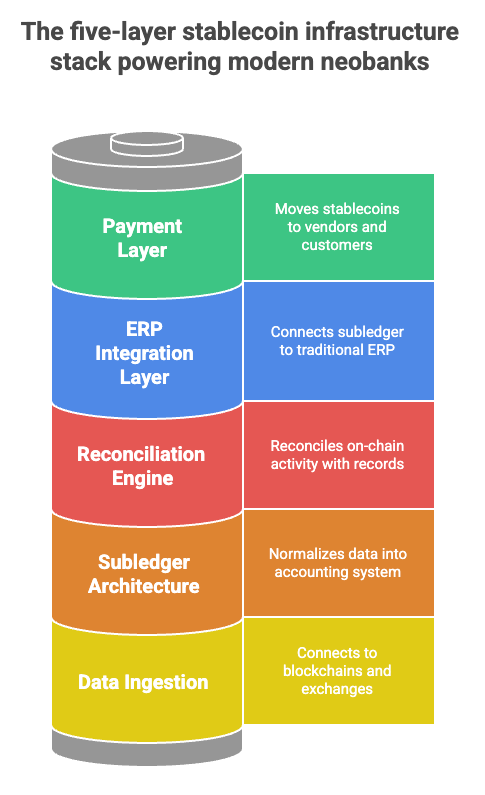
Use encryption or zero-knowledge protocols to hide transaction details like amounts and counterparties from the public view. While the blockchain confirms the transfer occurred, the specific data points remain encrypted. This ensures that competitors or malicious actors cannot analyze trading strategies or liquidity positions, maintaining the "private" aspect of the stablecoin for institutional users.
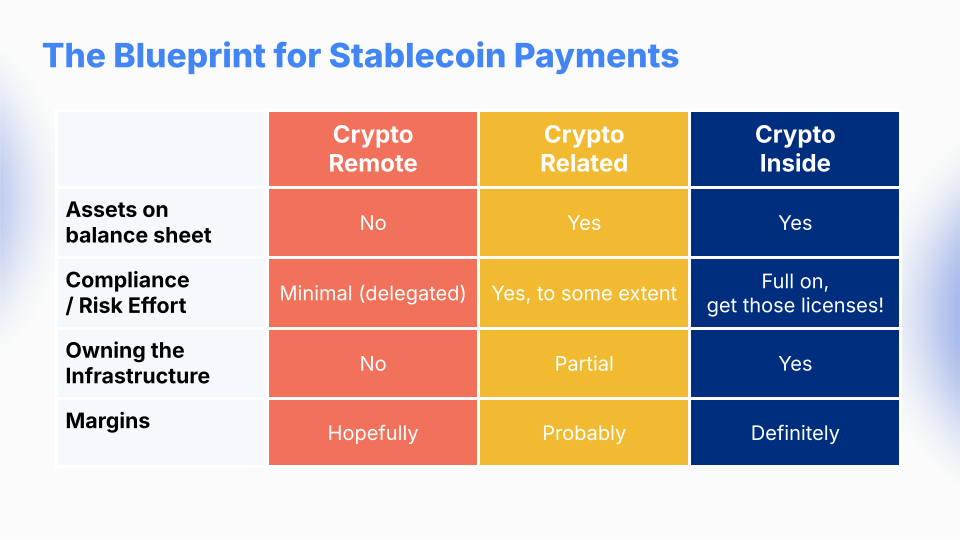
Embed automated Anti-Money Laundering (AML) checks into the transfer lifecycle. Before a transaction is finalized, the system should screen addresses against sanctions lists and flag suspicious patterns. Tools like Fireblocks provide the infrastructure to manage these risks, ensuring that every movement of funds is compliant with global regulatory standards without requiring manual intervention for every trade.
Create a secure, read-only portal for regulators. While the public sees encrypted data, authorized regulatory bodies should have the keys to decrypt and audit transaction histories. This "privacy with auditability" model satisfies compliance requirements by proving that the stablecoin issuer can trace funds if necessary, even if the general public cannot.
Test settlement flows before launch
Rigorous testing is the difference between a stablecoin infrastructure that scales and one that collapses under its own complexity. You are not just moving data; you are moving value that must settle instantly, securely, and in full compliance with regulatory mandates. Skipping this phase risks liquidity traps, failed audits, or worse, a breach of fiduciary duty.
Think of your test environment as a pressure cooker. It must simulate real-world friction: network congestion, partial failures, and compliance checks. If your settlement logic doesn’t hold up here, it will fail in production. The goal is to verify that every transaction—from minting to redemption—leaves an immutable, auditable trail that satisfies both technical and legal requirements.
Build a sandbox that mirrors production
Your testnet must replicate your mainnet’s architecture, including wallet services, oracle feeds, and compliance gateways. Use isolated environments to run integration tests without risking real assets. This ensures that any bugs or latency issues are caught before they impact users or regulators.
Simulate real-world transaction volumes
Load testing is non-negotiable. Generate thousands of concurrent transactions to stress-test your settlement engine. Monitor for bottlenecks in API responses, database locks, or blockchain confirmation delays. If your system slows down under load, it will fail during peak market hours.
Validate compliance checks at every step
Embed compliance logic directly into your test flows. Verify that sanctions screening, KYC/AML checks, and transaction limits trigger correctly. If a transaction should be blocked, it must be blocked instantly and logged. Regulatory bodies will expect this precision.
Run end-to-end settlement scenarios
Test the full lifecycle: minting, transfer, and redemption. Ensure that stablecoins are backed 1:1 by reserves at every step. Simulate reserve audits and prove that your infrastructure can provide real-time transparency to auditors and regulators.
Document and audit every test case
Keep detailed records of all test results, including failures and fixes. This documentation is your first line of defense during regulatory audits. It proves that you have exercised due diligence and that your system is robust, transparent, and compliant.
-
Verify sandbox mirrors mainnet architecture
-
Run load tests simulating peak transaction volumes
-
Confirm compliance checks trigger correctly for all transaction types
-
Test full lifecycle: minting, transfer, and redemption
-
Document all test results and audit trails
Track regulatory shifts and adapt infrastructure
Stablecoin regulation is not a static destination; it is a moving target. With the global fiat-backed stablecoin supply exceeding $273 billion by early 2026, the pressure from regulators is intensifying faster than the technology can stabilize. For institutions building private infrastructure, treating compliance as a one-time setup is a critical error. You need a system that detects regulatory changes and translates them into code updates.
Start by establishing a direct feed from primary sources. Relying on third-party news aggregators introduces latency and interpretation bias. Subscribe directly to the official registers of the jurisdictions where you operate or hold reserves. The European Union’s MiCA framework, for instance, requires specific reserve segregation and transparency reports. If your infrastructure does not automatically flag changes to these reporting standards, you are operating on borrowed time.
Build a compliance mapping layer into your core architecture. This means decoupling your business logic from your regulatory rules. When a new rule emerges—such as a change in KYC thresholds or reserve asset eligibility—your system should allow compliance teams to update parameters without a full redeployment. This agility is what separates robust institutional infrastructure from fragile prototypes. As noted by institutional finance leaders, the ability to adapt quickly to new regulatory demands is now a primary competitive advantage in the stablecoin space.
Finally, test your adaptation strategy regularly. Conduct "regulatory stress tests" where you simulate a sudden change in law and measure how quickly your infrastructure can respond. This ensures that when the next regulatory shift occurs, your team is reacting to the news, not scrambling to fix broken processes.
Frequently asked: what to check next
Are there any private stablecoins?
Yes. The majority of popular stablecoins are issued by private fintechs rather than central banks. For example, USD Coin (USDC) is issued by Circle, and Tether (USDT) comes from Tether Limited. These private companies create tokens in exchange for fiat deposits, manage the underlying reserves, and promise 1:1 redemption to maintain stability.
What is stablecoin infrastructure?
Stablecoin infrastructure refers to the technical systems, APIs, wallets, and protocols that enable businesses to accept, hold, send, and manage stablecoins at scale. Think of it as the backend plumbing that connects traditional business operations to digital currency payments. Without this layer, private stablecoins cannot function securely or efficiently.
Which crypto has the best infrastructure?
Infrastructure quality depends on your specific use case, such as compliance needs, transaction speed, or liquidity depth. While some networks are known for robust developer tools, the "best" choice is determined by how well the infrastructure supports your private stablecoin's regulatory and operational requirements. Evaluate providers based on audit trails and institutional-grade security rather than market cap alone.
No comments yet. Be the first to share your thoughts!