Defining private stablecoin infrastructure
Private stablecoin infrastructure operates on permissioned ledgers or privacy-preserving layers, distinct from public USDC or USDT. While consumer-facing tokens like USDC and USDT are issued by private fintechs to the general public, institutional infrastructure requires a different architectural approach. This distinction dictates the legal, technical, and operational framework for any enterprise strategy.
The core difference lies in identity and access. Public stablecoins allow anonymous wallet-to-wallet transfers, a feature that poses compliance risks for regulated entities. Private stablecoin infrastructure, by contrast, integrates Know Your Customer (KYC) and Anti-Money Laundering (AML) checks directly into the token lifecycle. As noted by Canton Network, this allows institutions to "tokenize and move on-chain cash... with the privacy you need" for capital markets and treasury operations, ensuring that transaction data remains visible only to authorized participants.
McKinsey highlights that while stablecoins can theoretically be sent between any two blockchain addresses, private infrastructure restricts this capability. It ensures that only verified entities can hold or transfer these assets. This permissioned nature transforms the stablecoin from a speculative or retail payment tool into a regulated settlement layer, suitable for interbank transfers, trade finance, and internal corporate treasury management.
Market research and regulatory alignment
Private stablecoins are not generic crypto tokens; they are financial instruments that must survive regulatory scrutiny. The majority of popular stablecoins, such as USD Coin and Tether, are issued by private fintechs that manage reserves and promise 1:1 redemption against fiat deposits. To build a private strategy for 2026, you must first map these assets against the emerging regulatory frameworks that will define their utility.
Align with SEC and national frameworks
The SEC’s Comprehensive Framework for Stablecoin Regulation outlines a clear path: private stablecoins must complement, not compete with, potential Central Bank Digital Currencies (CBDCs). Your market research should focus on issuers that demonstrate compliance with reserve auditing and redemption transparency. Ignoring these guidelines exposes your strategy to sudden delisting or legal action.
Simultaneously, you must evaluate national strategies. As noted by OMFIF, a global stablecoin clearing system allows financial institutions to receive foreign stablecoins and convert them to local currency. Identify which jurisdictions are actively building these clearing bridges. Assets operating in compliant jurisdictions offer the most stable foundation for a private strategy.
Track market cap trends
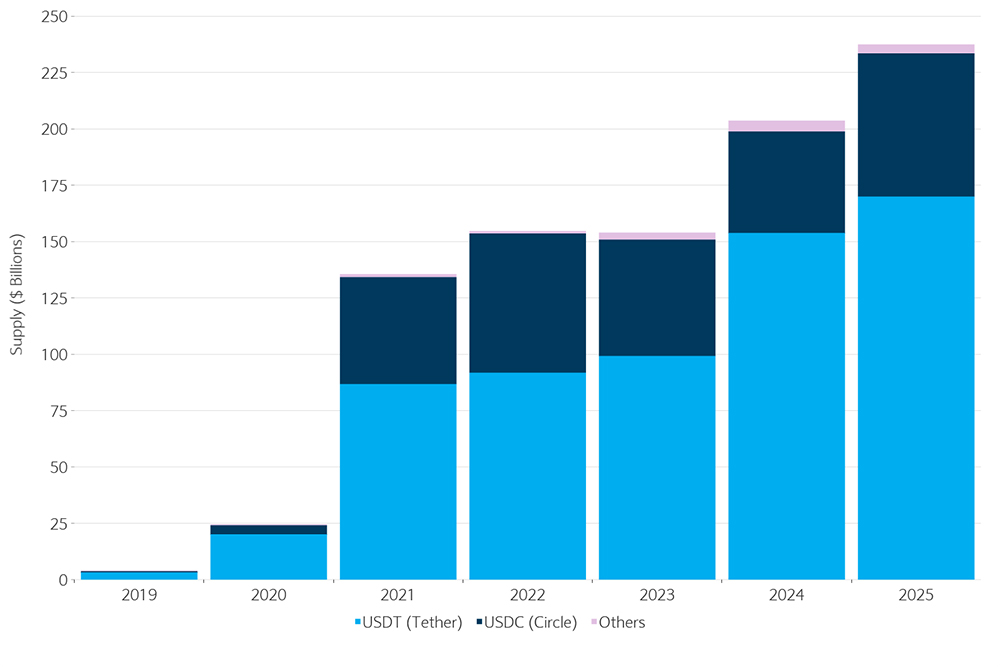
Regulatory alignment is meaningless without market liquidity. You need to see how capital is flowing into compliant private assets versus unregulated alternatives.
The chart above tracks the dominant private stablecoin, Tether (USDT), against the US Dollar. Observe the volume spikes during periods of regulatory news. These movements indicate how quickly capital shifts when compliance risks change. Use this data to time your entry into private stablecoin positions, ensuring you are aligned with both regulatory clarity and market momentum.
Selecting the right tools and partners
A private stablecoin strategy depends on infrastructure that supports interoperability and privacy. You need payment rails that allow your business to switch networks or pause usage if conditions change. This flexibility is essential for managing risk and maintaining operational continuity.
When evaluating infrastructure providers, focus on three core dimensions: privacy features, settlement speed, and regulatory readiness. Not all stablecoins are created equal. While major issuers like Circle (USDC) and Tether (USDT) are private companies managing fiat-backed reserves, their underlying infrastructure varies significantly in terms of on-chain privacy and compliance tooling.
The table below compares key infrastructure providers based on these criteria. This comparison helps you identify which partners align with your specific privacy and speed requirements.
| Provider | Privacy Features | Settlement Speed | Regulatory Readiness |
|---|---|---|---|
| Circle (USDC) | Standard (Public Ledger) | Near-instant (Multi-chain) | High (US-regulated, audited) |
| Tether (USDT) | Standard (Public Ledger) | Fast (Multi-chain) | Medium (Offshore, varying audits) |
| BVNK | Enhanced (Wallet-on-ramp) | Real-time (Local rails) | High (Licensed in multiple jurisdictions) |
| Stripe | Standard (Fintech integration) | Near-instant (Network dependent) | High (US-regulated, established) |
For stablecoin payouts, consider enabling users to create a wallet at the point of withdrawal. This approach improves adoption among non-crypto native users while maintaining your control over the underlying infrastructure. BVNK's approach highlights how local rails and embedded wallets can streamline this process. Choose partners that offer clear APIs for switching networks and robust compliance reporting to meet 2026 regulatory expectations.
Implementing the strategy step by step
Transitioning from research to deployment requires a structured workflow that balances regulatory compliance with technical integration. Financial institutions must move beyond pilot phases to establish production-grade infrastructure for private stablecoins.
Determine whether the stablecoin will be fiat-backed, asset-backed, or algorithmic, and select the underlying reserve assets. Define the minting and redemption mechanics, ensuring they align with the institution’s liquidity management capabilities and regulatory obligations. This foundational step dictates the token’s credibility and operational complexity.

Engage legal counsel to handle the evolving regulatory landscape, including anti-money laundering (AML) and know-your-customer (KYC) requirements. Obtain necessary licenses or exemptions in relevant jurisdictions. Establish clear legal agreements with reserve custodians and auditors to ensure transparency and compliance with local financial laws.
Develop or integrate the blockchain infrastructure required for issuance, transfer, and redemption. Audit smart contracts thoroughly to prevent vulnerabilities. Integrate with existing banking systems for fiat on-ramps and off-ramps, ensuring seamless settlement for institutional clients. Prioritize security and scalability to handle high transaction volumes.
Enable the stablecoin to function across various payment rails, including blockchain-based wallets and traditional banking interfaces. As noted by McKinsey, stablecoins can be sent between wallet addresses without requiring account openings at financial institutions, offering efficiency gains. Ensure compatibility with major enterprise wallets and payment processors to facilitate broad adoption.
Begin with a controlled pilot involving select institutional partners to test end-to-end workflows. Monitor transaction volumes, reserve balances, and user feedback closely. Use data analytics to refine operations and address any technical or compliance issues before a broader rollout. Establish a continuous improvement cycle to adapt to market changes and regulatory updates.
This phased approach ensures that private stablecoin initiatives are robust, compliant, and ready for institutional scale.
Frequently asked questions about private stablecoins
Helpful gear
Use these product recommendations as a starting point, then choose the size, material, and price point that fit how you actually use the gear.



As an Amazon Associate, we may earn from qualifying purchases.
No comments yet. Be the first to share your thoughts!