Define your settlement and compliance goals
Before writing a single line of code or selecting a blockchain provider, you must clarify why your institution needs private stablecoin infrastructure. The decision isn't just about technology; it is a strategic choice to balance regulatory control with operational efficiency.
Private stablecoin infrastructure allows institutions to maintain control over data visibility while leveraging public blockchain efficiency. Unlike public transactions where wallet addresses are pseudonymous and transparent to all, a private or permissioned ledger lets you manage identity verification and transaction monitoring according to your specific compliance framework. This is particularly important for institutions operating in jurisdictions with strict anti-money laundering (AML) and know-your-customer (KYC) requirements.
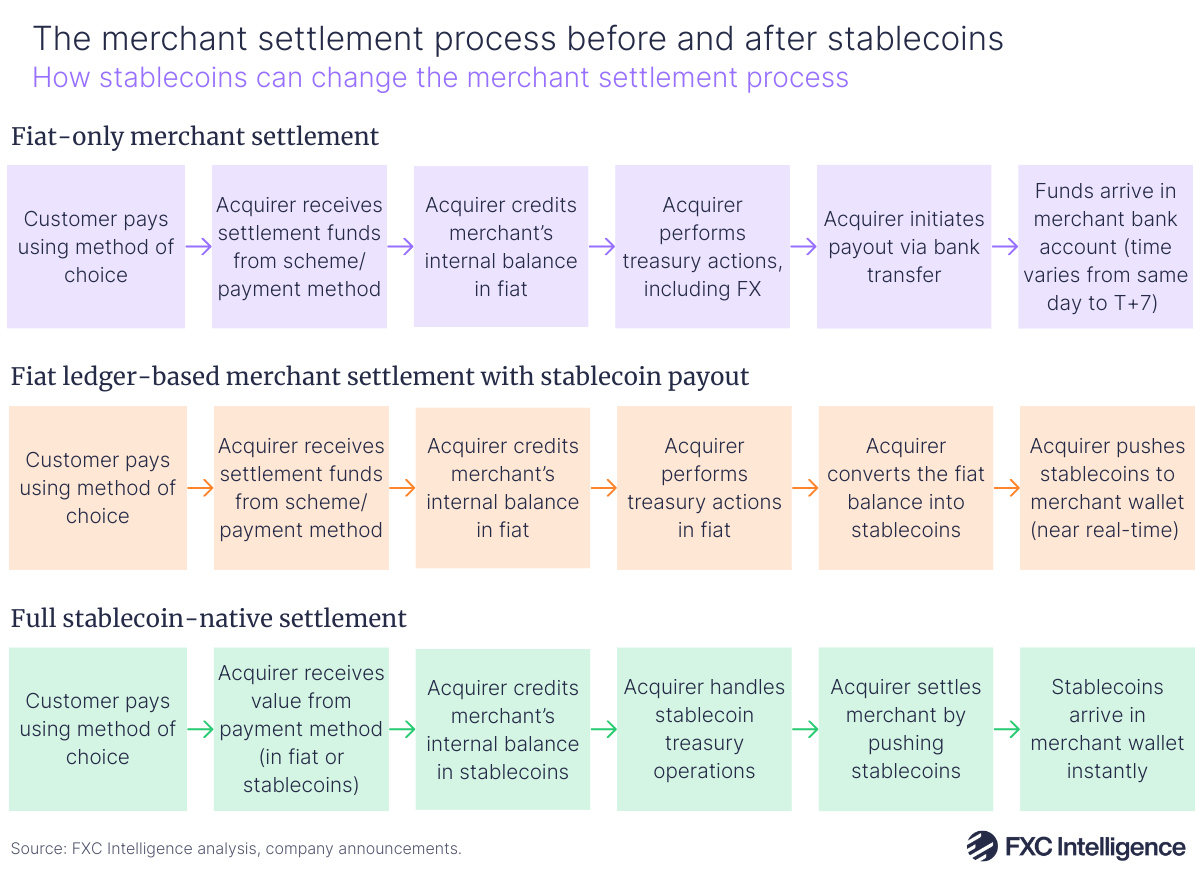
Settlement speed is the other critical driver. Traditional cross-border payments often rely on correspondent banking networks, which can take days to settle and involve multiple intermediaries. Stablecoins, by contrast, offer near-instant settlement. As noted by Morgan Stanley, stablecoins integrated into programmable infrastructures provide real-time settlement and low transaction costs, fundamentally modernizing financial infrastructure. This speed reduces counterparty risk and frees up capital that would otherwise be tied up in pre-funding accounts.
However, speed without compliance is a liability. Your goals should explicitly address how the stablecoin infrastructure integrates with existing regulatory reporting systems. You need to determine whether the infrastructure supports programmable compliance—such as automatic transaction screening or smart contract-based restrictions on certain wallet types. McKinsey highlights that stablecoins can be sent between blockchain addresses without traditional bank accounts, which expands reach but also complicates regulatory oversight. Therefore, your primary goal must be to build a system that is both fast and auditable.
Start by mapping your current settlement bottlenecks and compliance pain points. Identify which transactions are too slow, too expensive, or too opaque. Then, define what "compliance" means for your specific use case: is it about traceability, identity verification, or regulatory reporting? Once these goals are clear, you can select the appropriate technology stack that aligns with both your operational needs and regulatory obligations.
Select a compliant issuance and custody layer
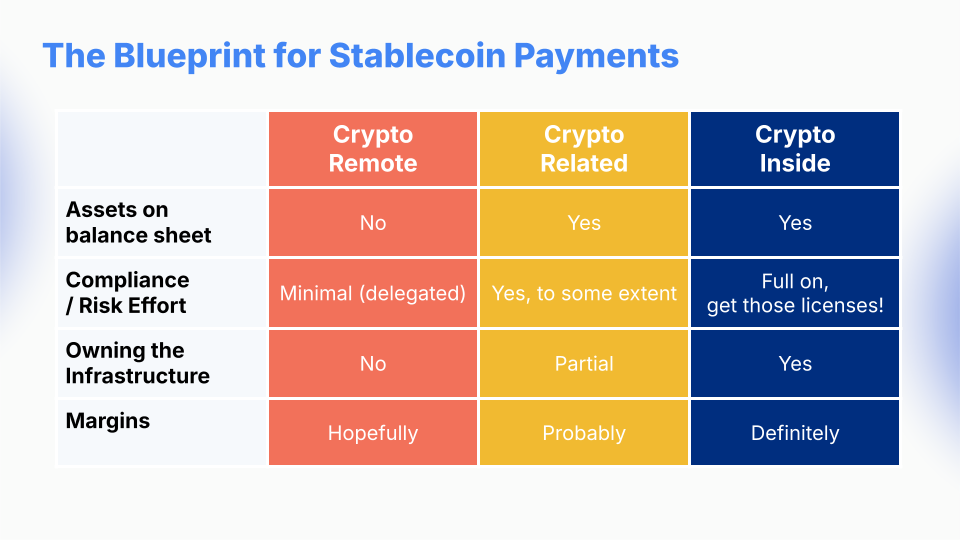
Building private stablecoin infrastructure requires more than just code; it demands a rigorous selection of partners who can handle the legal and technical weight of holding reserve assets. You are essentially choosing the vault and the bank for your digital currency. If the issuance layer fails to meet regulatory standards or the custody provider lacks proper insurance and security protocols, the entire project is at risk of being shut down or exploited.
The goal is to find providers that offer built-in compliance controls and efficient cross-border settlement capabilities. Fireblocks, for example, offers infrastructure designed to orchestrate stablecoin flows across different platforms and geographies while maintaining strict risk controls [src-serp-2]. This level of integration is critical for ensuring that your stablecoin operations remain compliant with anti-money laundering (AML) and know-your-customer (KYC) regulations in every jurisdiction you operate.
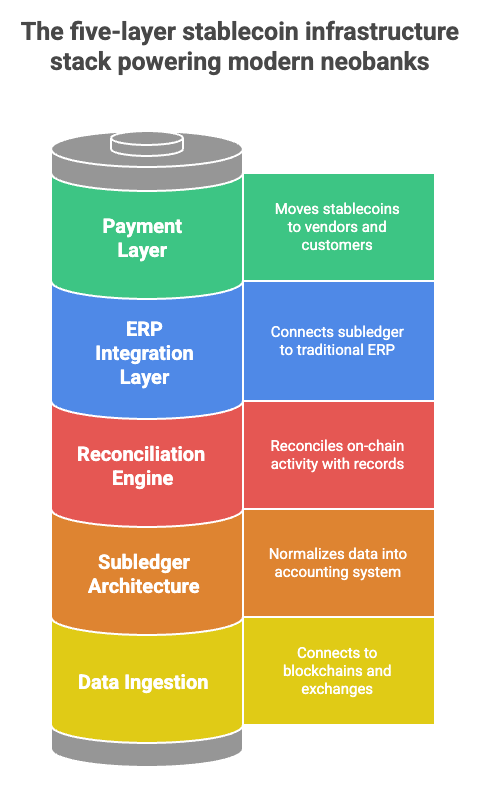
When evaluating potential partners, focus on their ability to support multi-chain deployments and their track record with institutional clients. The infrastructure must include interconnected layers for blockchains, reserves, digital wallets, and payments [src-serp-8]. Choose vendors who provide transparent auditing tools and real-time reporting to help you demonstrate compliance to regulators.
Before selecting a provider, map out the specific licensing and compliance obligations in each region where you plan to issue your stablecoin. This includes reserve requirements, reporting standards, and consumer protection laws. Ensure your chosen custody layer can support these varied legal frameworks without requiring separate, siloed systems for each jurisdiction.
Assess the technical security of the custody provider. Look for multi-signature wallet solutions, hardware security module (HSM) integration, and comprehensive insurance coverage for digital assets. The provider should offer clear proof of reserves and regular third-party audits to ensure that the stablecoin is fully backed and that the reserves are held securely.
Confirm that the issuance and custody platform integrates seamlessly with your compliance workflow. The provider should offer tools for transaction monitoring, sanctions screening, and automated reporting. This ensures that every transfer of your stablecoin is tracked and compliant, reducing the operational burden on your legal and compliance teams.


As an Amazon Associate, we may earn from qualifying purchases.
Implement privacy-preserving transaction flows
Building private stablecoin infrastructure requires a deliberate shift from public transparency to selective disclosure. In traditional blockchain environments, every transaction exposes the sender, receiver, and value to the entire network. For enterprise and regulated entities, this openness is a liability. The goal here is to structure flows that keep counterparty identities and pricing strategies hidden from the public ledger while remaining fully auditable by authorized regulators.
This approach relies on cryptographic techniques that allow validation without revelation. By using private transaction layers, you ensure that sensitive commercial data—such as who is paying whom and at what price—remains confidential. However, privacy cannot come at the cost of regulatory compliance. The system must still allow compliance officers and law enforcement to trace funds when legally required.
1. Configure private channels for counterparty data
The first step is to establish private communication channels between transacting parties. These channels allow data to be shared exclusively between the involved parties and authorized validators, excluding the broader network. This prevents competitors or public observers from seeing your trading partners or volume.
Establish encrypted channels between specific counterparties. This ensures that transaction details, including counterparty identities, are visible only to those directly involved and the necessary validators. This step is foundational for protecting commercial sensitivity in private stablecoin infrastructure.
Encrypt the actual data payload of the transaction. While the blockchain records that a transfer occurred, the specifics—such as the purpose of payment or negotiated pricing—are hidden. This maintains the integrity of the ledger without exposing sensitive business logic.
Deploy zero-knowledge proofs (ZKPs) to demonstrate compliance without revealing underlying data. ZKPs allow you to prove that a transaction meets regulatory criteria (e.g., anti-money laundering checks) without exposing the transaction's content to the public. This is critical for maintaining auditability in private stablecoin infrastructure.
2. Enable selective regulatory auditing
Privacy does not mean invisibility to regulators. You must build mechanisms that allow authorized entities to decrypt or view transaction details upon request. This is typically achieved through key escrow or threshold signatures, where multiple trusted parties must agree to reveal data.
3. Validate and monitor flow integrity
Finally, implement continuous monitoring tools that can detect anomalies within the private channels. These tools should operate on encrypted data where possible, using techniques like homomorphic encryption to analyze patterns without decrypting individual transactions. This ensures that the private stablecoin infrastructure remains secure and compliant over time.
By following these steps, you create a robust framework for private stablecoin infrastructure that balances commercial secrecy with regulatory transparency.
Integrate real-time regulatory reporting
Real-time regulatory reporting transforms private stablecoin infrastructure from a passive ledger into an active compliance tool. Instead of waiting for end-of-day reconciliation, your system pushes transaction data to regulators the moment it settles. This immediacy is non-negotiable for high-stakes environments where anti-money laundering (AML) and counter-terrorist financing (CTF) risks must be mitigated instantly.
To achieve this, you must build a direct, automated pipeline between your on-chain event listeners and regulatory APIs. This requires mapping every smart contract event—minting, burning, and transfer—to specific regulatory fields defined by bodies like FinCEN or the FCA. The goal is to eliminate manual data entry, which is prone to error and delay.
The following steps outline the technical sequence for establishing this integration.
Map every relevant on-chain event to a standardized regulatory schema. Identify which fields are mandatory for your jurisdiction (e.g., sender/receiver wallet addresses, transaction hash, timestamp, and amount). Ensure your smart contracts emit these events with sufficient granularity to satisfy audit requirements without exposing unnecessary user data.

Deploy a robust off-chain indexer or use an oracle service to monitor your stablecoin contract for new blocks. This listener must filter for specific event signatures and validate the data integrity before it enters your reporting pipeline. Accuracy here is critical; a missed event is a compliance failure.

Establish secure, authenticated connections to the relevant regulatory reporting endpoints. Use TLS 1.3 encryption for all data in transit. Implement retry logic with exponential backoff to handle temporary network failures, ensuring no transaction data is lost during transmission. Verify that your integration supports the specific payload format required by the regulator.

Before pushing data to the regulator, run it through an internal compliance engine. This step checks for sanctions list hits, unusual transaction patterns, or threshold breaches. If a transaction fails validation, flag it for manual review rather than auto-reporting, preventing false positives that could disrupt legitimate user activity.
Set up continuous monitoring for the reporting pipeline. Track latency, error rates, and successful submission counts. Generate daily audit logs that prove your system is functioning correctly. These logs are your primary evidence during regulatory examinations, demonstrating that your private stablecoin infrastructure is compliant by design.
This integration is not a one-time setup. Regulatory requirements evolve, and your reporting schema must adapt accordingly. Regularly review updates from financial authorities to ensure your private stablecoin infrastructure remains aligned with current legal standards.
Test settlement flows before production
Before moving your private stablecoin infrastructure to live environments, you must validate settlement flows under stress. A single failure in the chain—from blockchain execution to reserve reconciliation—can trigger compliance breaches or financial loss.
Stablecoin infrastructure relies on interconnected layers, including blockchains, reserves, and compliance modules Bridge. Testing these layers in isolation is insufficient; you must validate their interaction under stress to identify gaps before they become liabilities.
Frequently asked questions about private stablecoin infrastructure
How do regulators view private stablecoin infrastructure?
Regulators primarily focus on reserve backing, anti-money laundering (AML) controls, and consumer protection. Private issuers must demonstrate that their infrastructure can handle real-time settlement while maintaining strict compliance with local financial laws. As noted by Morgan Stanley, modernizing financial infrastructure through stablecoins requires balancing programmability with regulatory oversight to ensure stability and trust.
Is the technical complexity too high for traditional institutions?
Integrating private stablecoin infrastructure requires significant updates to existing ledger systems and compliance workflows. However, the complexity is manageable when built on established frameworks that support programmable money. Stripe’s guide highlights that businesses need to understand the underlying systems that maintain steady value and reliable transfers, emphasizing that infrastructure is about more than just token issuance—it’s about the entire operational ecosystem.
What are the typical costs associated with building this infrastructure?
Costs vary based on whether you build in-house or partner with existing providers. Expenses include legal compliance, technology development, and ongoing reserve management. While initial setup can be substantial, the long-term efficiency gains from real-time settlement and reduced transaction fees often offset these investments for high-volume institutions.
No comments yet. Be the first to share your thoughts!