Why enterprises need private rails
Public blockchains offer speed, but they lack the discretion required for institutional finance. When major banks and corporations move capital, they cannot broadcast their positions to the entire network. Private stablecoin infrastructure provides the necessary separation between public settlement layers and private transaction data, allowing enterprises to maintain confidentiality while leveraging programmable money.
The shift toward private rails addresses two critical institutional barriers: compliance and counterparty risk. Public DeFi protocols are transparent by design, meaning every transaction history is visible. This openness is incompatible with regulatory frameworks like GDPR or industry-specific privacy laws. Private infrastructure allows institutions to validate transactions against internal compliance rules before they are settled, ensuring that only authorized parties can view or interact with specific data streams.
Callout: The transition from public transparency to private, compliant settlement layers is essential for institutional capital to enter the digital asset space without exposing sensitive trade secrets or violating privacy regulations.
According to Morgan Stanley, stablecoins offer real-time settlement and low transaction costs, but these benefits are only fully realized when integrated into programmable infrastructures that respect enterprise privacy standards. Barclays further notes that stablecoins are evolving into a new generation of financial infrastructure, one that must balance the efficiency of blockchain with the rigor of traditional banking compliance. For enterprises, this means moving beyond public testnets to dedicated, permissioned networks where privacy is a feature, not an afterthought.
Core components of the stack
Building private stablecoin infrastructure requires stitching together four distinct technical layers. Each layer serves a specific function in the lifecycle of the token, from creation to final settlement. When these components align, the system operates with the reliability expected in institutional finance.
The first layer is issuance and minting. This is where fiat reserves are converted into digital tokens on a blockchain. Institutions typically use smart contracts to automate this process, ensuring that every token in circulation is backed by an equivalent asset. This step establishes the foundational value of the stablecoin.
Custody is the second layer and often the most scrutinized. Private stablecoin infrastructure demands institutional-grade security. Digital assets must be stored in multi-signature wallets or hardware security modules that prevent unauthorized access. This layer protects the underlying reserves from theft or loss, maintaining the integrity of the token's backing.
Settlement and payments form the third layer. This involves the actual movement of value between parties. Modern infrastructure leverages blockchain networks to enable near-instant settlement, bypassing the delays of traditional banking rails. This efficiency is a primary driver for enterprises adopting stablecoins for cross-border transactions.
Compliance and monitoring constitute the final layer. Every transaction must be traceable to meet regulatory requirements. Infrastructure providers embed compliance checks directly into the transaction flow, screening for sanctions and ensuring adherence to anti-money laundering (AML) standards. This ensures that the private stablecoin operates within legal boundaries.
Key tools for implementation
Building a private stablecoin infrastructure requires more than just a token; it demands a secure, compliant backbone for custody, settlement, and privacy. For finance professionals, the choice of provider dictates how easily your institution can manage liquidity while keeping transaction data off the public ledger. The landscape is shifting from experimental pilots to production-grade systems that handle institutional scale.
| Provider | Primary Focus | Privacy Model | Settlement Speed |
|---|---|---|---|
| Ripple | Cross-border payments & custody | On-chain visibility with private channels | Near-instant (NFT Ledger) |
| Fireblocks | Institutional custody & transfer | Multi-party computation (MPC) custody | Varies by network (optimized) |
| Canton Network | Interoperable private assets | Protocol-level data isolation | Async across connected ledgers |
Ripple has established itself as a leading provider for stablecoin-powered cross-border payments. Its infrastructure leverages the XRP Ledger to offer digital asset custody solutions that are specifically designed for institutional needs. By using private channels, financial institutions can settle transactions without exposing counterparty details to the public network, ensuring that sensitive trade flows remain confidential while benefiting from the speed of blockchain settlement.

For institutions prioritizing custody and internal transfer security, Fireblocks provides a multi-party computation (MPC) framework. This approach eliminates single points of failure in key management, which is critical for private stablecoin operations where asset security is paramount. Fireblocks integrates with major blockchains, allowing firms to manage stablecoin liquidity across different networks with a unified interface and strict compliance controls.
Canton Network offers a different architectural approach by focusing on interoperability and protocol-level privacy. Instead of relying on a single ledger, Canton allows institutions to issue and access stablecoins that move freely between connected ledgers without exposing pricing, counterparties, or strategies. This "programmable privacy" enables complete composability, meaning private stablecoins can interact with other financial instruments across different institutional boundaries while keeping data siloed at the protocol level.



As an Amazon Associate, we may earn from qualifying purchases.
Selecting the right tool depends on your institution's primary pain point. If cross-border liquidity is the bottleneck, Ripple’s network offers immediate integration with existing correspondent banking workflows. If internal risk management and key security are the concerns, Fireblocks provides the necessary custody rigor. For complex, multi-institutional ecosystems requiring data isolation, Canton Network’s interoperable model is the most robust fit for private stablecoin infrastructure.
Market trends and adoption signals
The shift from speculative crypto trading to enterprise-grade private stablecoin infrastructure is no longer a theoretical exercise. We are seeing a distinct pivot where regulatory clarity and institutional adoption are driving actual deployment. The market is moving past the "build it and they will come" phase into a period of rigorous integration, where the focus is on compliance, liquidity, and interoperability.
Regulatory frameworks are finally providing the guardrails necessary for large-scale adoption. Institutions are no longer waiting for perfect legislation; they are operating within emerging guidelines that define custody, reserve transparency, and cross-border settlement rules. This clarity reduces legal risk, allowing banks and payment processors to build stablecoin rails that meet traditional financial standards.
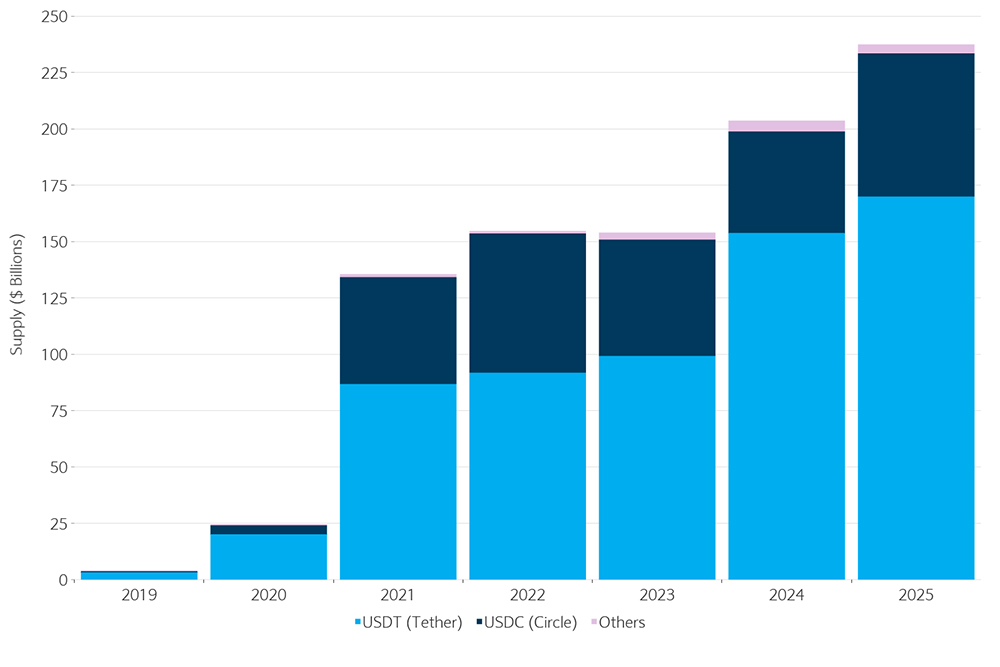
Adoption rates are accelerating, particularly in cross-border payments and treasury management. According to Stripe, stablecoin infrastructure is becoming the backbone for modern business payments, offering speed and cost advantages that legacy systems cannot match. Similarly, McKinsey highlights that tokenized cash can be sent between blockchain-based wallet addresses without requiring the owners to open accounts at traditional financial institutions, significantly lowering barriers to entry for global commerce.
For 2026 readiness, the signal is clear: private stablecoin infrastructure is transitioning from a niche tool to a core component of enterprise finance. Companies that invest in compliant, interoperable systems now will have a decisive advantage in a market where speed and certainty are the primary currencies.
Steps to deploy private rails
Deploying private stablecoin infrastructure requires a disciplined approach that prioritizes security and compliance from day one. Unlike public networks, private rails offer controlled access but demand rigorous internal governance. The following workflow outlines the essential phases for integrating these systems into existing financial operations.
Begin by mapping the specific use cases for your private stablecoin infrastructure. Determine which assets will be tokenized and who will have access. Align these definitions with regulatory requirements such as AML/KYC protocols. This foundational step ensures that the architecture supports legal obligations before technical implementation begins.

Choose a permissioned ledger that offers the necessary throughput and privacy features. Configure node permissions and consensus mechanisms to suit your enterprise’s risk tolerance. Ensure the platform supports smart contract functionality for automated settlement while maintaining strict access controls for administrators.
Secure the private keys associated with the stablecoin reserves using institutional-grade custody solutions. Implement multi-signature requirements and hardware security modules (HSMs) to prevent unauthorized access. This step is critical for maintaining the integrity of the reserve backing the private stablecoin infrastructure.
Embed real-time monitoring tools directly into the transaction flow. These systems should automatically flag suspicious activity and enforce transaction limits based on predefined risk parameters. Integrate with existing KYC databases to verify participant identities before granting network access.
Before going live, perform extensive stress testing and security audits. Simulate high-volume transaction scenarios to identify bottlenecks or vulnerabilities. Engage third-party auditors to review smart contracts and infrastructure design. This validation phase is essential for ensuring the reliability of the private stablecoin infrastructure under real-world conditions.
Deploy the system to a limited group of internal users or trusted partners. Monitor performance and compliance metrics closely during this phase. Use feedback to refine processes and address any issues before expanding to a broader user base.
No comments yet. Be the first to share your thoughts!