Why private stablecoin infrastructure matters now
Enterprise finance is moving away from the public transparency of early crypto adoption. Companies no longer want their settlement strategies, counterparty relationships, or pricing models exposed on a public ledger. Instead, they are turning to private stablecoin infrastructure to execute high-volume transactions while keeping sensitive business data confidential.
This shift addresses a fundamental tension in digital assets: the need for programmable efficiency versus the requirement for commercial secrecy. Public blockchains offer transparency, but that visibility can be a liability for competitors or a compliance risk for regulated entities. Private stablecoin infrastructure solves this by enabling programmable privacy. It allows assets to move freely and remain fully composable with public financial rails without revealing the underlying transaction details to the broader network.
The regulatory landscape further drives this adoption. Financial institutions must adhere to strict anti-money laundering (AML) and know-your-customer (KYC) standards. A permissioned layer allows firms to verify counterparties internally while keeping the transaction data restricted to authorized participants. This approach aligns with the growing demand for "private money" that operates within proprietary, compliant infrastructures rather than fragmented public pools.
As major financial players like Morgan Stanley and Stripe integrate digital assets, the expectation is that enterprise settlement will not mirror the public retail experience. It will be a closed-loop system where privacy is a feature, not a bug. This infrastructure ensures that stablecoins can function as effective settlement layers for global commerce without sacrificing the confidentiality required by modern business operations.
Core components of enterprise settlement rails
Building private stablecoin infrastructure requires more than just issuing tokens; it demands a layered architecture that bridges traditional finance with blockchain rails. The foundation rests on three interconnected pillars: custody, oracles, and compliance hooks. Each layer must operate with institutional-grade security to ensure that settlement is both real-time and auditable.
Custody and Digital Wallets
Custody is the bedrock of enterprise stablecoin operations. Unlike retail wallets, institutional custody solutions must manage private keys with multi-signature protocols and hardware security modules (HSMs). Fireblocks provides a prime example of this layer, offering a unified platform that manages digital assets across multiple blockchains while enforcing strict transaction policies. This infrastructure ensures that the reserves backing the stablecoins are secure, transparent, and readily available for redemption.
Oracle Integration
Stablecoins rely on external data to maintain their peg and value. Oracles act as the bridge between on-chain smart contracts and off-chain real-world data. Chainlink’s infrastructure is widely adopted for this purpose, providing tamper-proof data feeds that ensure the stablecoin’s value remains accurate even during periods of high volatility. Without reliable oracles, the smart contracts governing the stablecoin cannot execute trades or rebalance reserves effectively.
Compliance and Settlement Hooks
Finally, compliance hooks integrate regulatory checks directly into the transaction flow. These hooks allow enterprises to screen transactions against sanction lists and monitor for suspicious activity in real-time. By embedding compliance at the protocol level, private stablecoin infrastructure can offer real-time settlement across geographies without the friction of traditional intermediary banks, as noted by Fireblocks. This integration ensures that every transaction is not only fast but also legally compliant.
| Provider | Custody Solution | Compliance Feature | Settlement Speed |
|---|---|---|---|
| Fireblocks | HSM & Multi-sig | Policy Engine | Real-time |
| Bridge | Institutional-grade | Embedded KYC | Real-time |
| Chainlink | N/A (Oracle) | Data Integrity | N/A (Data Feed) |
Market trends shaping 2026 adoption
The conversation around private stablecoin infrastructure has shifted from theoretical pilots to tangible integration. Major financial institutions are no longer asking if they should adopt this technology, but rather how to embed it into existing settlement layers without disrupting current operations. This transition is driven by the need for real-time finality and reduced counterparty risk in high-value transactions.
Morgan Stanley highlights that stablecoins offer a unique advantage by being pegged to the dollar while integrating into programmable infrastructures. This combination allows for real-time settlement and significantly lower transaction costs compared to traditional wire transfers. For enterprise clients, this means capital efficiency improves as funds are no longer tied up in multi-day clearing processes. The focus is on leveraging this infrastructure for cross-border payments and internal liquidity management.
Barclays Private Bank describes stablecoins as the new generation of financial infrastructure, emphasizing their role in maintaining steady value through fiat pegs. This stability is critical for enterprise adoption, where volatility is an unacceptable risk. By treating stablecoins as a foundational layer rather than a speculative asset, banks can offer clients faster, cheaper, and more transparent services. The trend points toward a hybrid model where private stablecoins operate alongside traditional banking rails, providing the speed of crypto with the compliance of regulated finance.
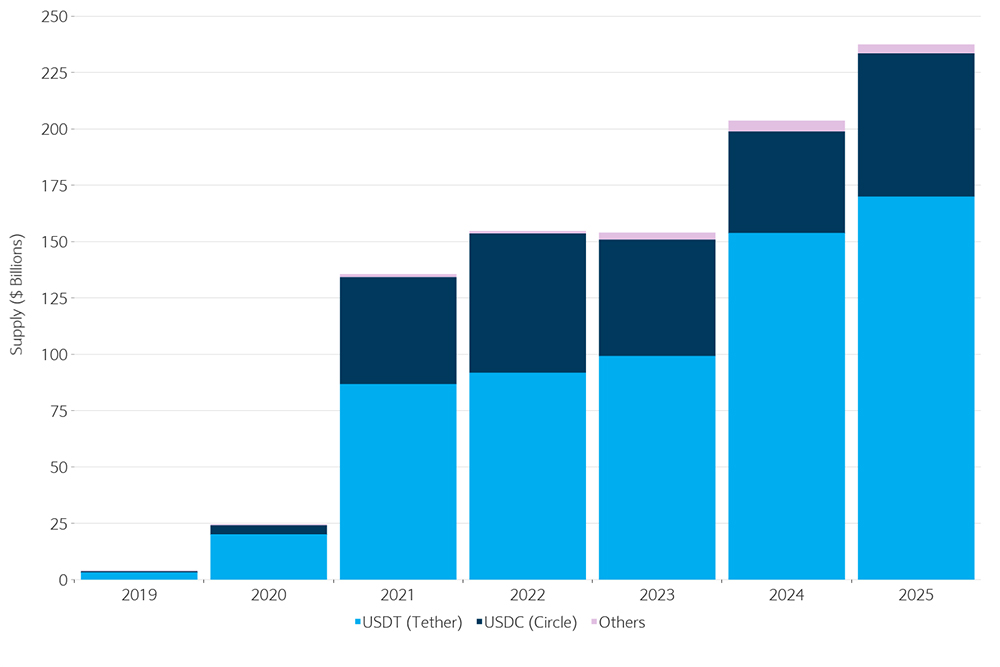
To understand the broader market context, it is useful to look at the performance of major stablecoins like USDT and USDC. Their liquidity and volume trends reflect the growing trust in these instruments as settlement assets.
Building private stablecoin infrastructure
Implementing private stablecoin infrastructure requires moving beyond pilot projects to production-grade systems. For enterprises, the goal is reliability and compliance, not just experimentation. This section outlines the practical steps to build or integrate these systems securely.
Start by mapping where stablecoins fit into your existing treasury and payment workflows. Identify which transactions benefit most from settlement speed and which require traditional rails for regulatory reasons. This audit prevents unnecessary complexity and highlights where private stablecoin infrastructure can reduce friction.
Security is the foundation of any stablecoin strategy. Partner with a custodian that offers institutional-grade key management and insurance coverage. Look for providers that support multi-party computation (MPC) or hardware security modules (HSMs) to protect private keys. This step ensures that asset custody meets enterprise risk standards.
Use established APIs or SDKs from providers like Stripe or Fireblocks to handle transaction lifecycle management. These tools abstract away the complexity of blockchain interaction, allowing your engineering team to focus on business logic. Ensure the integration supports both testnet and mainnet environments for thorough testing before launch.
Private stablecoin infrastructure must include automated compliance layers. Integrate tools that screen transactions against sanctions lists and monitor for suspicious activity in real time. This proactive approach reduces regulatory risk and ensures that your stablecoin operations remain aligned with global financial regulations.

Before a full rollout, test the system with internal teams or a small group of trusted partners. Use this phase to validate settlement times, error handling, and user experience. Gather feedback to refine the process and address any technical or operational gaps before scaling to broader enterprise use.
By following these steps, enterprises can build a robust private stablecoin infrastructure that balances innovation with security. The result is a payment system that is faster, cheaper, and more transparent than traditional alternatives.
Top tools for private stablecoin strategy
Building private stablecoin infrastructure requires specialized platforms that balance regulatory compliance with the speed of public blockchains. The following tools represent the current standard for enterprises managing institutional-grade digital assets.
Fireblocks
Fireblocks provides a comprehensive custody and transfer platform designed for high-volume stablecoin operations. It offers multi-party computation (MPC) technology to secure private keys without exposing them to any single point of failure. This setup allows institutions to execute real-time settlements across geographies while maintaining strict internal controls. The platform supports a wide range of stablecoins, enabling seamless integration with existing treasury management systems. Fireblocks focuses on reducing operational risk through automated compliance checks and transparent audit trails.
Stripe
Stripe has emerged as a critical infrastructure layer for businesses seeking to accept and manage stablecoin payments. Their API-first approach allows companies to integrate stablecoin processing directly into their checkout flows, converting crypto to fiat instantly if needed. This tool is particularly effective for merchants who want the speed of blockchain settlement without the volatility risk. Stripe’s infrastructure handles the complex routing and compliance checks required for cross-border transactions. For more on how businesses can leverage this, see Stripe’s guide on stablecoin infrastructure.
Canton Network
For enterprises requiring deep programmable privacy, the Canton Network offers a unique approach to private stablecoin payments on public blockchains. It allows institutions to issue and access stablecoins that move freely without exposing pricing, counterparties, or trading strategies. This platform ensures complete composability while keeping sensitive financial data encrypted and isolated. It is ideal for high-net-worth private banking and institutional trading desks that require discretion. Canton Network enables privacy-preserving interactions that traditional public ledgers cannot support.
As an Amazon Associate, we may earn from qualifying purchases.
No comments yet. Be the first to share your thoughts!